
What has recently entered into force?
Updated mortgage advice guidelines 2026
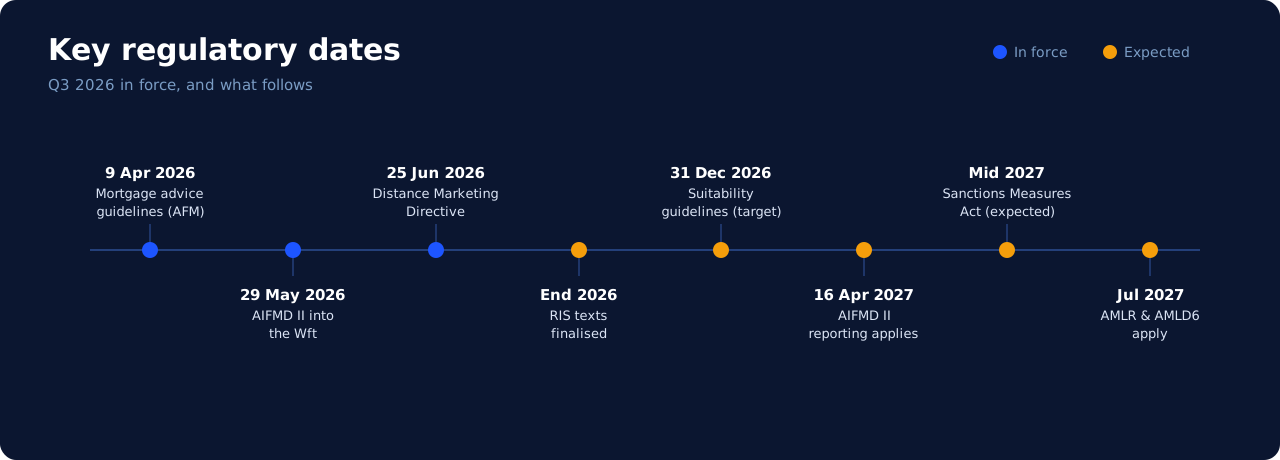
On 9 April 2026, the AFM published the updated Mortgage Advice Guidelines 2026, replacing the previous version. The revised guidance gives mortgage advisers updated, practical direction on delivering suitable advice, with greater emphasis on:
- the adviser’s independent role
- asking follow-up questions where inconsistencies arise
- applying proportionality
- considering sustainability
- addressing relationship breakdowns
AIFMD II transposed into the Wft
On 29 May 2026, the Implementation Act amending the AIFM Directive and the UCITS Directive entered into force. It transposes Directive (EU) 2024/927 (AIFMD II) into the Dutch Financial Supervision Act (Wet op het financieel toezicht, Wft).
The amendments concern, among other things:
- delegation arrangements
- liquidity risk management
- depositaries
- loan origination by alternative investment funds
The revised supervisory reporting requirements follow on a separate date: 16 April 2027.
Distance Marketing Directive implemented
On 25 June 2026, the Implementation Act and the Implementation Decree for the Distance Marketing Directive entered into force. Financial institutions that offer services online or through distance channels must now meet enhanced requirements on:
- consumer information
- withdrawal rights
- the design of digital sales processes
These obligations apply in addition to existing sector-specific legislation.
MiFID II retail investor protection: the Retail Investment Strategy
Applies to: investment firms, and managers of alternative investment funds (AIFs) and UCITS, that provide investment services to retail investors.
Retail participation in EU capital markets remains significantly lower than in other major economies. In 2021, only around 17% of EU household assets were invested in financial instruments (listed shares, bonds, investment funds and derivatives), compared with 43% in the United States. Contributing factors include limited access to information, low investor confidence in capital markets, relatively high costs for retail investors, and misleading marketing practices on social media.
The Retail Investment Strategy (RIS) aims to enable retail investors to make better-informed decisions that more closely match their needs and objectives. It introduces amendments across several frameworks, including MiFID II, AIFMD, the UCITS Directive and the PRIIPs Regulation.
What is set to change:
- Costs and value for money. Investment firms must identify and quantify all costs and charges borne by investors and assess whether these are proportionate. Products with total costs that cannot be objectively justified may no longer be approved for distribution.
- Clearer disclosures. The Key Information Document (KID) will be revised to provide clearer information on costs, risks and expected returns. In the longer term, this information must also be available in a machine-readable format.
- Tighter inducement rules. To reduce conflicts of interest, advisers will face an explicit obligation to demonstrate that they act in the client’s best interests, and inducement-related costs must be disclosed separately.
- Simplified suitability for straightforward products. For advice on diversified, non-complex and cost-efficient products, the requirement to assess the client’s knowledge and experience is removed.
- Easier opt-up. The criteria for retail clients to opt up to professional client status will be amended, allowing experienced investors to qualify more easily.
The current objective is to finalise the legislative texts by the end of 2026, with the new rules applying no later than 30 months after publication.

International Sanctions Measures Act
Applies to: all institutions within the scope of the Dutch Sanctions Act 1977.
Work on this has been underway since July 2023. The aim is to bring the Dutch sanctions regime into closer step with European sanctions legislation, and to make supervision and enforcement more effective.
The proposed International Sanctions Measures Act introduces several important changes:
- a modernised legal basis for giving effect to international sanctions, with clearer rules on how the Netherlands applies them
- the option of administrative enforcement for sanctions breaches, in addition to the criminal route that already exists
- dedicated enforcement powers for serious breaches or attempts to circumvent sanctions
- scope to manage and administer assets and economic resources that remain frozen for long periods
- a legal footing for connecting sanctions data to a range of public registers
- better information exchange between competent authorities, supervisors and enforcement bodies included
- a central reporting office for sanctions
- wider governance and compliance oversight that now also captures legal professionals, including lawyers, civil-law notaries and accountants
The bill was submitted to the Dutch House of Representatives on 19 February 2026 and is currently under parliamentary consideration. It is expected to enter into force in mid-2027.
In addition, on 15 April 2026 the Minister of Foreign Affairs launched a public consultation on a second legislative package. This tranche focuses specifically on the internal governance and compliance processes of institutions and will, where possible, be aligned with the European Anti-Money Laundering Package.
Institutions already subject to that package will therefore not need to implement additional measures under the second tranche. This exemption does not apply to non-life insurers and pension funds, which will rely entirely on the new legislation.
The intention is for these changes to coincide with the application of the Anti-Money Laundering Regulation (AMLR) and the Sixth Anti-Money Laundering Directive (AMLD6) in July 2027, reducing the number of separate implementation milestones for institutions.
Revised suitability guidelines for management bodies and key function holders
Applies to: banks and investment firms.
Between 25 February and 25 May 2026, ESMA and the EBA ran a public consultation on revised joint guidelines introducing new requirements arising from the revised Capital Requirements Directive (CRD). They will replace the existing joint EBA/ESMA Guidelines of 2 July 2021.
The principal changes:
- Wider scope. The guidelines will apply to all institutions, investment firms and third-country branches, requiring a comprehensive suitability assessment of all key function holders, rather than only members of the management body and a limited number of key positions. Key function holders are individuals who exercise significant influence over the management of an institution without being members of the management body, including the heads of internal control functions and the Chief Financial Officer where they are not board members.
- New risk lenses. Institutions must explicitly consider ESG, AI/ICT, and anti-money laundering and counter-terrorist financing (AML/CFT) risks when carrying out suitability assessments, going considerably further than the previous version.
- Detailed AML/CFT expectations. Institutions must assess explicit and detailed risk factors, including sectoral risks, business relationships, geographical risks and links to sanctions lists. At least one member of the management body must possess specific expertise in AML/CFT risks and regulatory obligations. Supervisors must also reassess suitability whenever there are reasonable grounds to suspect AML/CFT risks, in consultation with the relevant AML/CFT authorities.
- Stronger independence and diversity requirements. These include a cooling-off period for former executive directors before they may assume supervisory positions, and more detailed, prescriptive diversity and gender-balance requirements that oblige institutions to demonstrate active management of board composition.
- More demanding training. Institutions must allocate sufficient resources and expand mandatory training programmes to cover ESG, AML/CFT, ICT and AI-related risks.
The revised guidelines are expected to enter into force six months after publication of the final text, with 31 December 2026 currently envisaged as the implementation deadline.
Looking ahead: what's on the horizon
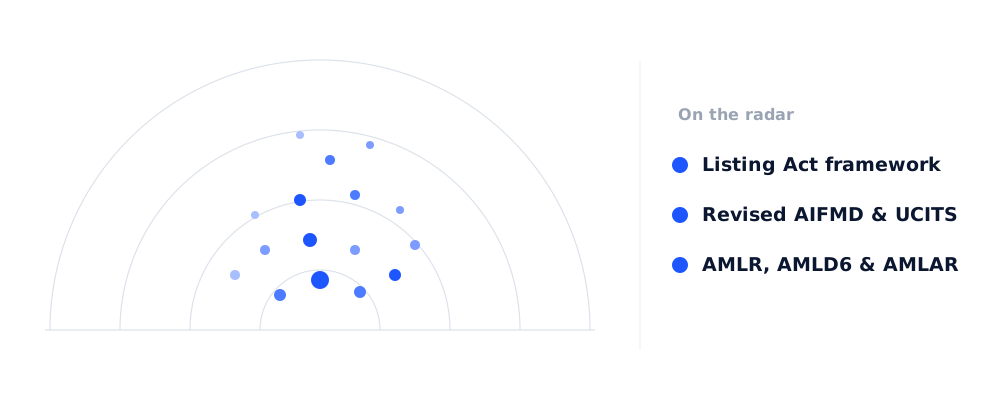
Further legislative and regulatory developments to prepare for include:
- the European Listing Act framework
- secondary legislation implementing the revised AIFMD and UCITS Directive
- secondary legislation under the AMLR, AMLD6 and AMLAR
Stay on top of every change
Staying on top of changes like these starts with knowing the moment they land. Ruler helps compliance teams keep track of regulatory developments across DNB, AFM, ESMA, EIOPA, EBA and more, so you’re always one step ahead.