
What has recently entered into force?
FIU-the Netherlands can have transactions postponed
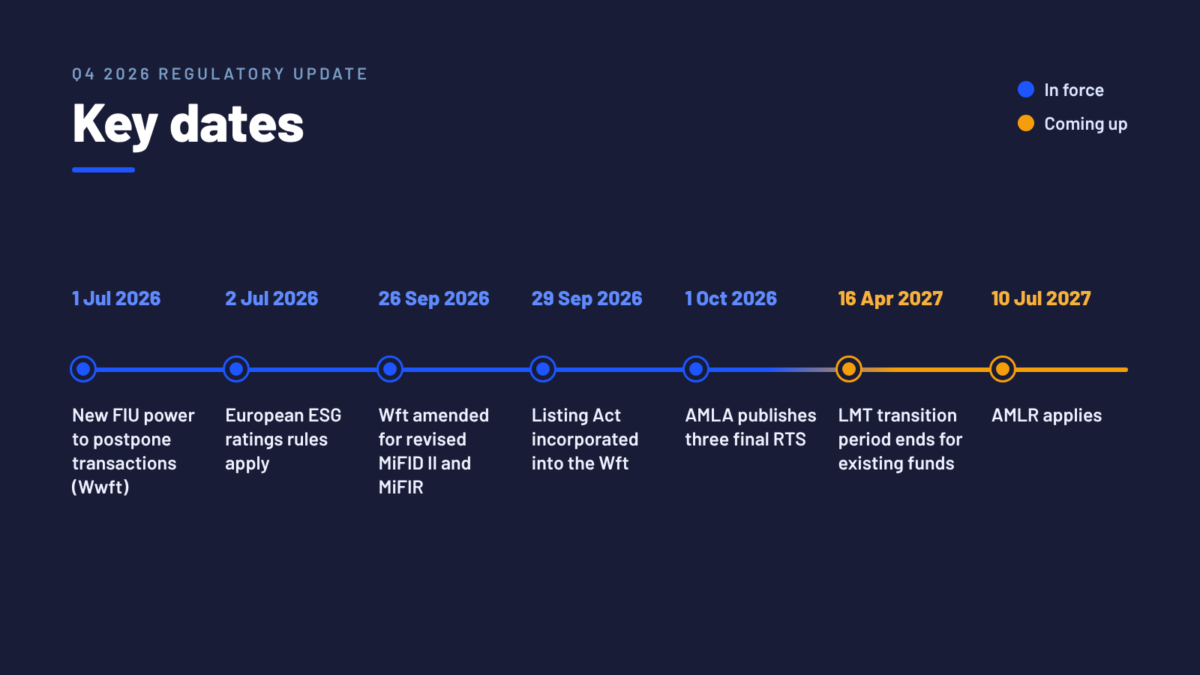
As of 1 July 2026, FIU-the Netherlands can request an institution to temporarily postpone one or more transactions where there are indications that they are linked to money laundering or terrorist financing (Article 17a of the Dutch Anti-Money Laundering and Anti-Terrorist Financing Act, Wwft). A postponement lasts a maximum of five working days, or ten where the request is made on behalf of a foreign FIU.
The law requires institutions to have procedures in place for this. Update your reporting procedures accordingly, so that they set out:
- who receives such a request;
- how the transaction is postponed in practice;
- how the client is informed without delay, as the law requires.
New European rules for ESG ratings
As of 2 July 2026, the new European rules for ESG ratings apply. They mainly target ESG rating providers, but they also affect financial institutions themselves.
Using an in-house ESG rating in your marketing?
Then you must explain on your website how that rating is produced, including:
- the methodology;
- the data sources;
- the weighting of ESG factors;
- potential conflicts of interest.
The marketing communication itself must include a link to this explanation. This applies to financial market participants and financial advisers (Article 13(3) SFDR) and to other regulated financial undertakings (Article 2(2)(c) of the ESG Ratings Regulation).
Using ratings from external providers?
A transitional regime applied to existing providers. Their ratings could be published or distributed until 2 November 2026, provided the provider had notified ESMA in time that it would apply for authorisation. Since that date, this is only permitted if the provider is included in ESMA’s register. Check whether your provider is included in ESMA’s register.
Wft amended for the revised MiFID II and MiFIR
Since 26 September 2026, Dutch rules have been aligned with the revised MiFID II and MiFIR. The changes cover, among other things:
- the definition of systematic internaliser;
- standards for the quality of trade data that trading venues submit to the consolidated tape provider;
- the removal of the periodic reporting obligation on the execution of client orders (best execution).
What does this mean for investment firms?
They no longer need to report periodically on the execution of client orders and can update their best execution procedures and reporting calendar accordingly. The best execution obligation itself remains fully in place.

The Listing Act: easier access to European capital markets
Applies to: issuers and investment firms.
For small and medium-sized enterprises in particular, listing on an EU exchange is often complex and costly. The Listing Act therefore aims to make access to European capital markets simpler and cheaper. The package consists of three parts:
- a regulation that simplifies the prospectus rules, the market abuse rules (MAR) and MiFIR;
- a directive that amends, among other things, the admission requirements for a listing and the MiFID II rules on research;
- a directive that allows companies to issue multiple-vote shares when listing on a multilateral trading facility (MTF), including an SME growth market.
Some of the changes already apply. The first changes have applied since December 2024. Since 5 March 2026, the new prospectus regimes have applied: the EU Follow-on prospectus and the EU Growth issuance prospectus. In the third quarter of 2026, the framework was fleshed out further.
Dutch implementation: lower barriers to listing
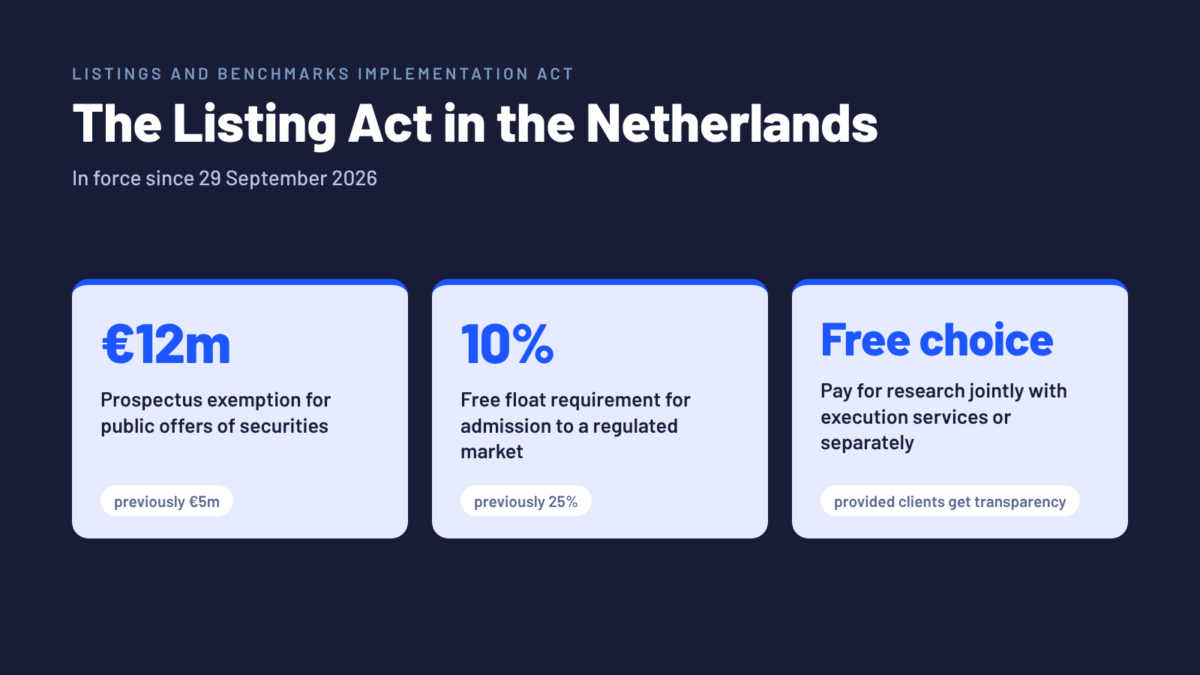
On 29 September 2026, the Dutch Listings and Benchmarks Implementation Act (Implementatiewet noteringen en benchmarks) entered into force. It incorporates the Listing Act and the amended European benchmark rules into the Wft. The directive on multiple-vote shares is being transposed through a separate bill.
- Prospectus exemption up to €12 million. The Netherlands has adopted the European exemption threshold: public offers of securities up to €12 million are exempt from the obligation to publish a prospectus (previously €5 million). For such an exempt offer, an information document must still be made public and the offer must be notified to the AFM in advance.
- Free float requirement down to 10%. Listing becomes more accessible as the free float requirement for admission to trading on a regulated market falls to 10% (previously 25%).
Research: a free choice on how to pay
For investment firms, the change to the rules on research is particularly relevant.
- As of 29 September 2026, investment firms may once again choose whether to pay for research jointly with execution services or separately, provided transparency towards clients is ensured.
- Where research is paid for from a client-funded Research Payment Account (RPA), additional requirements apply.
- Since 7 September 2026, an EU code of conduct has applied to research paid for by an issuer. Only research produced in accordance with this code may be labelled as issuer-sponsored research.
Prospectus rules further detailed
- Since 10 July 2026, rules have applied to submitting prospectus information and the associated metadata to the national competent authority (the AFM in the Netherlands). This is so that the information will become centrally available through the European Single Access Point (ESAP), which must be operational by 10 July 2027.
- Since 16 August 2026, a standardised format has applied to prospectuses, including the EU IPO prospectus. In addition, issuers of certain non-equity securities must include additional ESG information in their prospectus.
- On 9 September 2026, ESMA published draft rules on the key financial information in the prospectus summary. It is now up to the European Commission to adopt them.
- On the same date, ESMA published guidelines on when issuers can add new securities to a base prospectus by means of a supplement.
Market abuse rules further detailed
- Since 5 July 2026, issuers have had to keep their insider lists in a revised, mandatory European format.
- On 16 July 2026, further European rules were published on market manipulation and managers’ transactions, and on the disclosure of inside information in protracted processes, such as merger negotiations. They flesh out what the Listing Act has provided for in MAR since 5 June 2026: in such processes, not every intermediate step needs to be disclosed any more, and the rules on delaying disclosure have also been amended.
AIFMD II and the UCITS Directive: the secondary legislation takes shape
Applies to: AIFMs and UCITS management companies.
As discussed in our previous update, the revision of the AIFM Directive and the UCITS Directive was implemented in the Wft as of 29 May 2026. The revision mandates ESMA to draw up further rules on several points, among other things to further harmonise and standardise supervisory reporting and the provision of information to supervisors.
Liquidity management tools (LMTs)
Liquidity management tools (LMTs) are a key element.
- European rules per LMT. Since 16 April 2026, European rules have set out, for each LMT, how the tool works, such as the calculation method and how it is activated.
- ESMA guidelines. These cover the selection, calibration and application of LMTs.
- Transition period. For existing AIFs and UCITS, a transition period until 16 April 2027 applies to both the European LMT rules and the ESMA guidelines.
Nonetheless, according to the AFM, managers of open-ended funds already had to select LMTs by 16 April 2026 and record them in their policy and in the fund rules or instruments of incorporation. Managers can also choose to apply the European LMT rules to existing funds earlier, but must then notify the AFM.
In practice, more clarity is still needed on, among other things:
- how this fits with future reporting;
- the supervisor’s expectations during the transition period;
- the application of LMTs within existing fund structures.
More extensive supervisory reporting
AIFMs
Annex IV reporting is being revised and expanded. In technical standards, ESMA sets out what managers must report, in how much detail, how often and in which format. The new reporting is expected to provide more insight into, among other things:
- liquidity profiles and risks;
- the use of LMTs;
- leverage;
- exposures and concentration risks;
- delegation structures.
Until the new standards apply, current Annex IV reporting continues to apply. ESMA expects the new reporting to go live in the first half of 2029 at the earliest. Even so, it is advisable to start structurally recording the data needed for future reporting now.
UCITS management companies
For the first time, they will be subject to explicit periodic reporting obligations. These are expected to cover the liquidity risks of UCITS, the use of LMTs and additional fund information for macroprudential supervision. In substance, this reporting is aligned with that for AIFMs. ESMA is working on a single integrated reporting framework for both.
Stricter rules on outsourcing and delegation
The rules on outsourcing and delegation are being tightened in both directives, with particular attention to preventing letter-box entities (regardless of where the delegate is located) and to the transparency of governance and delegation structures. Supervisory reporting is expected to require more detail on:
- delegated and sub-delegated functions;
- the entities and jurisdictions involved;
- how the manager exercises oversight;
- the risks of complex delegation structures.
Open-ended loan-originating AIFs
For open-ended AIFs that originate loans, ESMA has drawn up draft rules on the conditions under which these funds may retain an open-ended structure. These include requirements on:
- the liquidity management system;
- the availability of liquid assets;
- stress testing;
- a redemption policy appropriate to the fund’s liquidity profile.
They also set out the factors managers must take into account when assessing liquidity and designing the redemption policy. The European Commission has indicated that it will not adopt these rules before 1 October 2027.
The AML package: AMLA fleshes out the AMLR
Applies to: all obliged entities under the AMLR.
The European anti-money laundering package further harmonises the rules on preventing money laundering and terrorist financing across the EU.
- 10 July 2027: the Anti-Money Laundering Regulation (AMLR) becomes applicable. By then, the Sixth Anti-Money Laundering Directive (AMLD6) must largely have been transposed into national law.
- From 2028: the EU Authority for Anti-Money Laundering and Countering the Financing of Terrorism (AMLA) will directly supervise a selection of cross-border, high-risk financial institutions.
What the new rules look like in practice will largely be determined by the secondary legislation AMLA is currently drafting. The main topics on which AMLA has drawn up (draft) rules or guidelines are:
- customer due diligence: which information institutions must collect and verify about their customers;
- business relationship or occasional transaction: when a business relationship exists and how linked transactions are identified;
- group-wide policies: minimum requirements for group-wide policies and information sharing within the group, including with establishments in third countries;
- business-wide risk assessment: minimum requirements for the content and execution of the business-wide risk assessment (BWRA);
- ongoing monitoring: how institutions keep monitoring business relationships to detect unusual transactions in time;
- direct AMLA supervision: the criteria AMLA uses to determine which institutions come under its direct supervision.
Three standards finalised
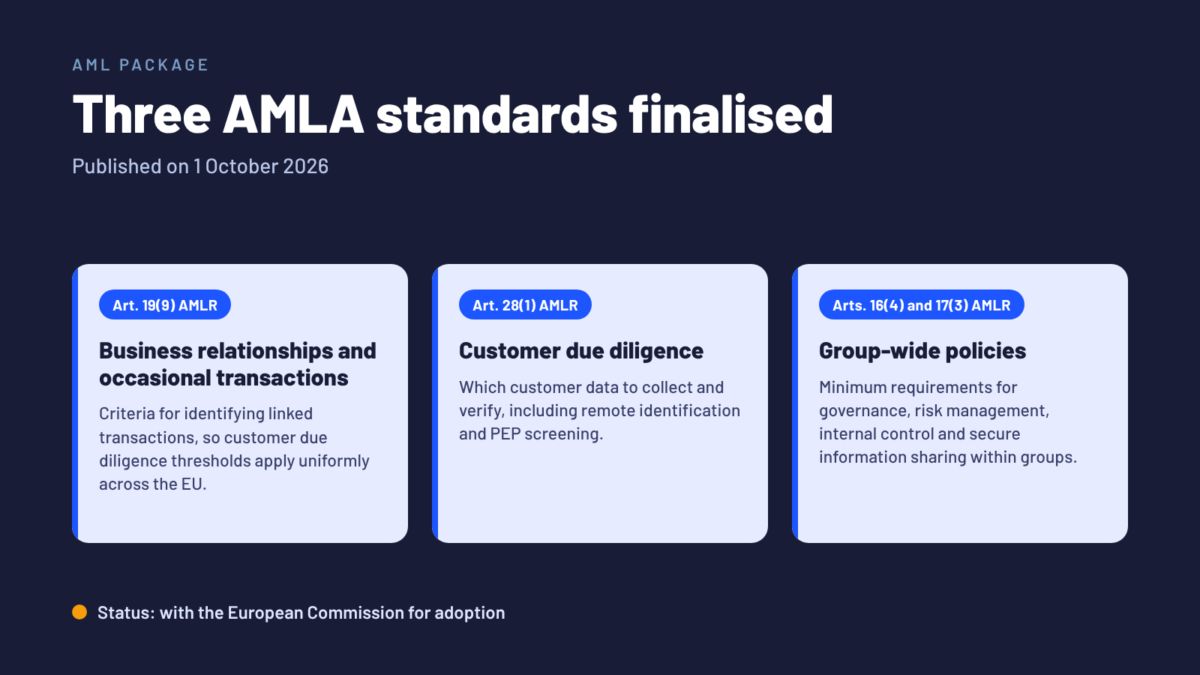
Although this falls just outside the reporting period of this update, we want to flag an important development: on 1 October 2026, AMLA published the final versions of the regulatory technical standards (RTS) for three of these topics. This brings more clarity on how obliged entities must comply with the AMLR.
- Business relationships and occasional transactions (Article 19(9) AMLR). The standard clarifies when there is an ongoing business relationship and when there is an occasional transaction, and sets criteria for identifying linked transactions. This ensures that customer due diligence thresholds are applied in the same way across the EU.
- Customer due diligence (Article 28(1) AMLR). The standard determines which customer data institutions must collect and verify. Where the risk is lower, a risk-based and proportionate approach is possible. The standard also contains rules on remote digital identification and verification, and on screening politically exposed persons (PEPs), their family members and close associates.
- Group-wide policies (Articles 16(4) and 17(3) AMLR). The standard sets minimum requirements for governance, risk management and internal control within groups, provides for secure information sharing between group entities, and includes additional measures for subsidiaries and branches in third countries.
The standards are now with the European Commission for adoption. AMLA proposes that they apply six months after their entry into force.
Looking ahead
Which upcoming legislation and regulation should you also take into account? In our next regulatory update, we will look at, among other things:
- the Regulation on a framework for Financial Data Access (FIDA);
- the simplification of financial transaction reporting;
- the guidelines on disclosure requirements under the Prospectus Regulation.
Stay on top of every change
Staying on top of changes like these starts with knowing the moment they land. Ruler helps compliance teams keep track of regulatory developments across DNB, AFM, ESMA, EIOPA, EBA, AMLA and more, so you are always one step ahead.